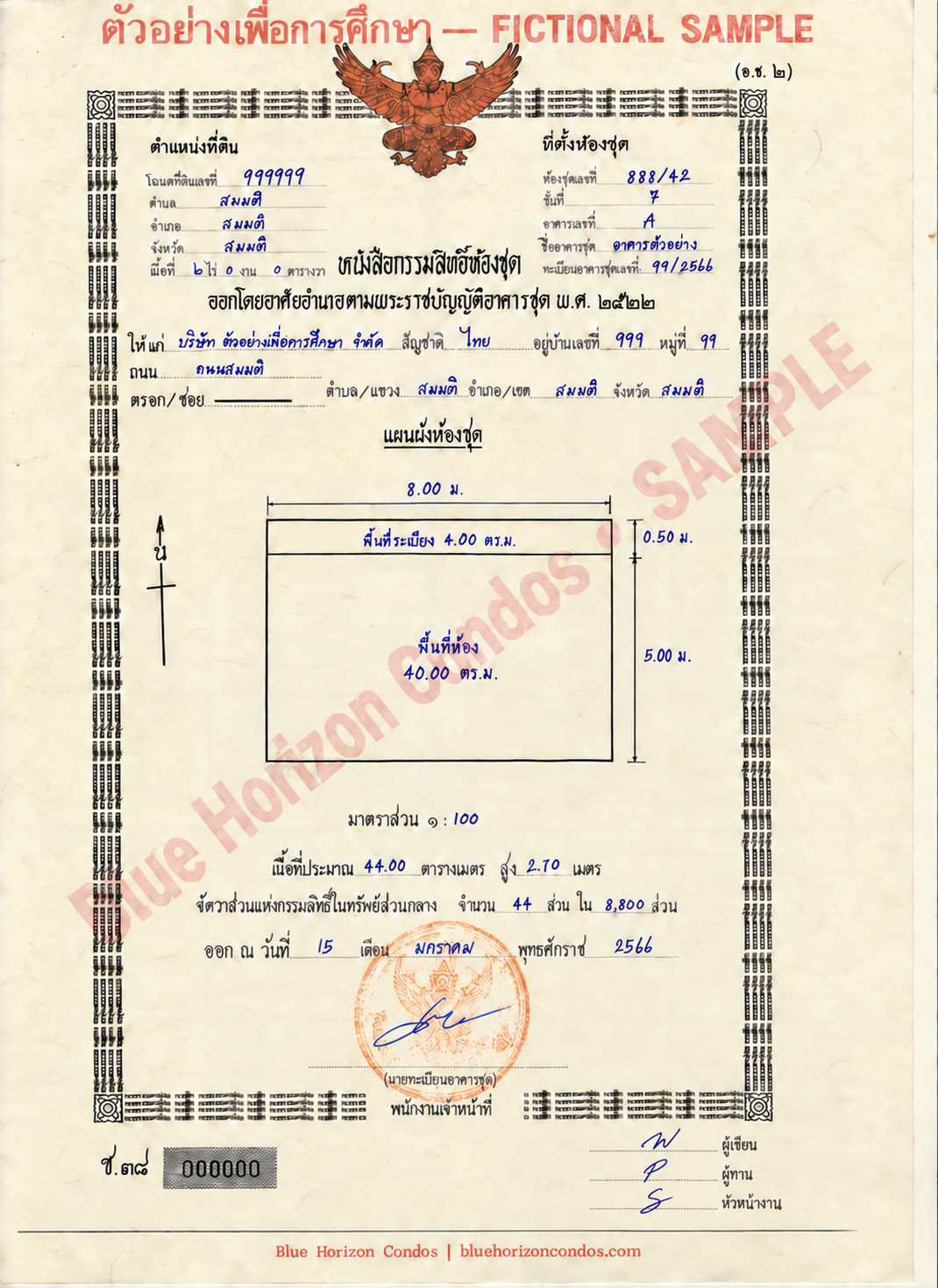
Find the unit, its registered area and its share of the common property. Then turn it over to follow the registered history.
Read the document heading
หนังสือกรรมสิทธิ์ห้องชุด
This heading identifies a condominium ownership certificate, often called a “condo Chanote”. A land Chanote has a different heading: โฉนดที่ดิน. Start with the heading, especially on a black-and-white copy.
What to check: A condo certificate describes a unit and its share of common property. Choose “Land Chanote” if your document says โฉนดที่ดิน.
Department of Lands · Condominium Act ↗(opens in a new tab)Land beneath the condominium
ตำแหน่งที่ดิน
The upper-left block identifies the condominium’s underlying land: title reference, locality and land area. This is not the floor area of your apartment. Our fictional example uses deed reference 999999 and 2 rai.
What to check: Keep the underlying land reference separate from the unit number at the upper right.
Department of Lands · Condominium Act ↗(opens in a new tab)The registered unit identity
ที่ตั้งห้องชุด
Look for the unit number, floor, building number, condominium name and condominium registration reference. In this example, the legal unit number is 888/42 on floor 7 in the fictional Example Residence.
What to check: A sales label such as “A-704” is not necessarily the registered number. Ask the juristic office to confirm the link between the sales label and the legal unit number.
Department of Lands · Condominium Act ↗(opens in a new tab)The person named when issued
ให้แก่
This names the person or company to whom the certificate was first issued. For a newly registered condominium, this may be the developer’s company. In our example, the company is the developer. Later sales are recorded in the registration history, so its name can remain on the front long after a buyer takes ownership.
What to check: Do not assume the front-side name is still the current owner. Read all later registrations and confirm the current Land Office record.
Department of Lands · Condominium Act ↗(opens in a new tab)The registered unit plan
แผนผังห้องชุด
The plan shows the unit’s outer boundary, balcony boundary and measurements; it does not show doors or windows in this example. This invented plan has an 8.00 × 5.00 m room (40.00 m²) plus an 8.00 × 0.50 m balcony (4.00 m²): 44.00 m² in total. The room and balcony labels explain how this example totals 44.00 m².
What to check: Read each area label on your own plan. Do not add a balcony again if it is already included in the stated total. Screen size does not preserve the original drawing scale.
Department of Lands · Condominium Act ↗(opens in a new tab)Total area and height
เนื้อที่ประมาณ / สูง
The line below the plan states the unit area and height. Our example reads 44.00 square metres and 2.70 metres high. Compare the deed’s figures with the sale contract and listing.
What to check: Do not confuse square metres (ตารางเมตร / ตร.ม.) with square wah (ตารางวา), which appear in land measurements.
Department of Lands · Condominium Act ↗(opens in a new tab)Share of common property
อัตราส่วนแห่งกรรมสิทธิ์ในทรัพย์ส่วนกลาง
This is a ratio of common-property ownership. The invented example is 44 parts out of 8,800, or 0.5%. It is not an extra 44 m² of private space and it is not a foreign-ownership quota figure.
What to check: Read the numerator and denominator together. For charges, also check the condominium’s registered rules and applicable fee basis.
Department of Lands · Condominium Act ↗(opens in a new tab)The issue date
ออก ณ วันที่
This example was issued on 15 January 2566 (2023). The later sale, mortgage and discharge have their own dates on the reverse.
What to check: Read a date with its label: issuance, registration and printing are different events.
Department of Lands · Condominium Act ↗(opens in a new tab)The issuing official’s seal and signature
พนักงานเจ้าหน้าที่ / ประทับตรา
The circular red-orange ink impression accompanies the issuing official’s signature. Section 21 of the Condominium Act includes the official signature and seal among the certificate’s contents. The sample shows a worn impression and an invented signature.
What to check: This is separate from the printed Garuda above. Read the stamp with the signature and nearby wording; appearance alone does not confirm the current registered record.
Department of Lands · Condominium Act ↗(opens in a new tab)Printed form-control number
หมายเลขแบบพิมพ์
The serial strip at the lower left identifies the printed certificate form. The Land Office controls its stock of title forms and records the form numbers used. This sample uses 000000. It is separate from the underlying land-deed reference and registered unit number above.
What to check: If asked for this reference, copy the whole printed string, including its prefix. Do not read the small prefix as a year or province code without confirmation from the Land Office.
Department of Lands · control of printed title forms ↗(opens in a new tab)Preparation and checking sign-offs
ผู้เขียน / ผู้ทาน / หัวหน้างาน
These three smaller sign-offs are for the staff who prepared the certificate (ผู้เขียน), checked it (ผู้ทาน) and supervised the work (หัวหน้างาน). Other editions use labels such as ผู้ตรวจ and หัวหน้าการ. They are separate from the main issuing official’s signature and seal inside the border.
What to check: These are office-processing details, not a list of owners or later property transactions. Follow the registration table for changes after issue.
Department of Lands · condominium title form and issue procedure ↗(opens in a new tab)